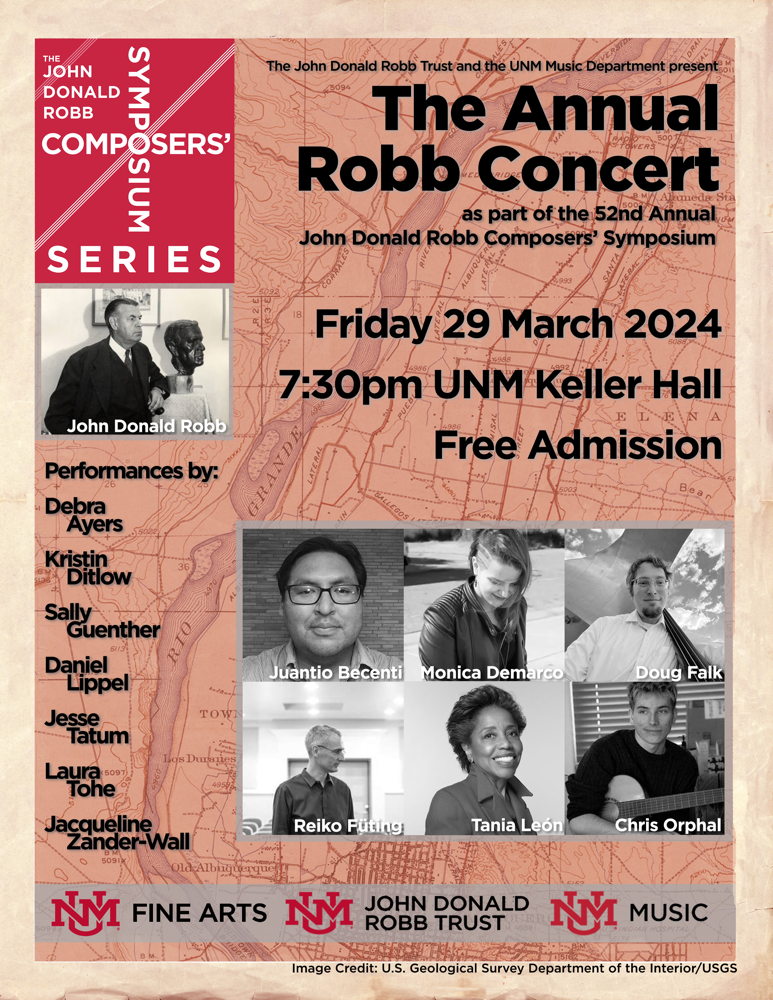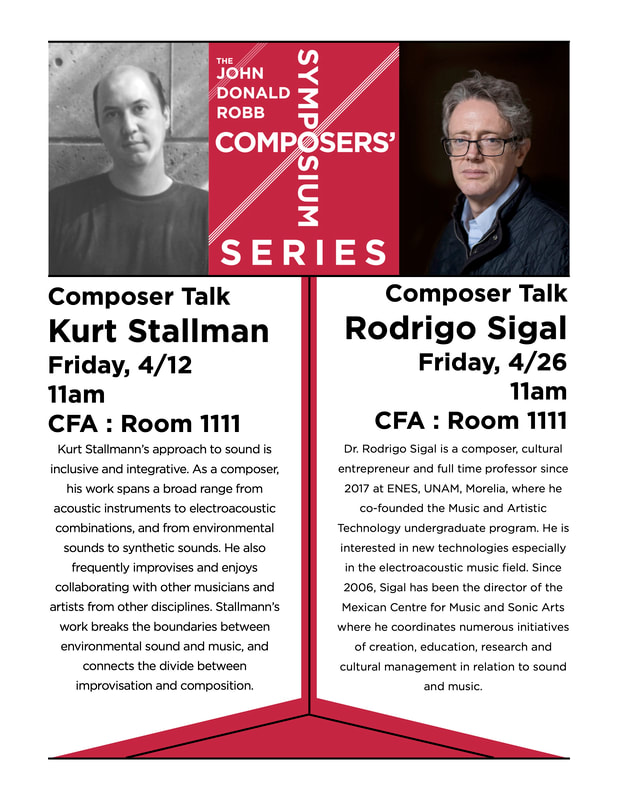
Robb Symposium Series
This page is not optimized for mobile devices. Use a computer, laptop, or tablet for optimal viewing.
Featured Event
New Music Piano Recital
Emanuele Arciuli
Tuesday 21 October 2025 7:30pm
Four World Premiere Compositions
Including Two Robb Trust Commissions
Free Admission
a family-friendly community event
Composers
Lucas Stafford, Carlos Santiago Medina, Emilio Méndez Rizo, Jonah Elrod*, Jessi Harvey*, Kyle Gann, Louis W. Ballard
Keller Hall at Center for the Arts (CFA)
University of New Mexico
College of Fine Arts
MSC04 2570
1 University of New Mexico
Albuquerque, NM 87131-0001
Directions
*Jessi Harvey and Jonah Elrod are recipients of the 2026 Robb Commission.
Emanuele Arciuli
Tuesday 21 October 2025 7:30pm
Four World Premiere Compositions
Including Two Robb Trust Commissions
Free Admission
a family-friendly community event
Composers
Lucas Stafford, Carlos Santiago Medina, Emilio Méndez Rizo, Jonah Elrod*, Jessi Harvey*, Kyle Gann, Louis W. Ballard
Keller Hall at Center for the Arts (CFA)
University of New Mexico
College of Fine Arts
MSC04 2570
1 University of New Mexico
Albuquerque, NM 87131-0001
Directions
*Jessi Harvey and Jonah Elrod are recipients of the 2026 Robb Commission.
Program Notes
Dripstrain (2025) — Lucas Stafford (b. 2004)
"Dripstrain" is a word created to capture the abstract impression of this piece. It evokes a sense of water droplets, falling and collecting, with a growing urge to go somewhere. The atmosphere is "straining," as if to collect itself into something yet unrealized.
The Corpse Of Aphrodite (2025) — World Premiere — Carlos Santiago Medina (b. 2003)
I. Very Slowly, Stumbling
II. Slowly, Aching
III. Heavy, Stomping
There
Her body swings
Rope around her neck
To the ceiling
A twitch of life every so often
My goddess has abandoned me
I am alone
Truly and completely
This temple is empty
Lifeless and hollow like her body
Cut the rope and bring her down
Place her in a bed of flowers
Mourn my loss
And jump off the cliff
For I am alone without Aphrodite
There is no one I love
And no one to love me
This temple once hallowed
Exists only as boneyard
And cemetery
So from this tough tree branch
I hang myself and break my neck
I. Very Slowly, Stumbling
II. Slowly, Aching
III. Heavy, Stomping
There
Her body swings
Rope around her neck
To the ceiling
A twitch of life every so often
My goddess has abandoned me
I am alone
Truly and completely
This temple is empty
Lifeless and hollow like her body
Cut the rope and bring her down
Place her in a bed of flowers
Mourn my loss
And jump off the cliff
For I am alone without Aphrodite
There is no one I love
And no one to love me
This temple once hallowed
Exists only as boneyard
And cemetery
So from this tough tree branch
I hang myself and break my neck
Suite-Toccata (2022) — World Premiere — Emilio Méndez Rizo (b. 1998)
V. Studio, Quasi un Minueto
The suite was composed during a trip in northern México at the end of 2021, my mother took me and my sister on a tour bus to celebrate the end of quarantine. The lovely landscapes and clear skies made me wonder in crystalline harmonies. At times, the foldings of the mountain ranges felt like my flesh.
At the beginning of the trip, I was tired of the piano, but as the trip progressed, I started yearning more and more for it. All chords were thought of to fit my hand. To invoke the mountain folds, cold breezes, and crystal skies by empathic positions on the keyboard.
These explorations culminated with 3 tone rows, presented at the very beginning in the left hand. Everything that follows is included in them.
V. Studio, Quasi un Minueto
The suite was composed during a trip in northern México at the end of 2021, my mother took me and my sister on a tour bus to celebrate the end of quarantine. The lovely landscapes and clear skies made me wonder in crystalline harmonies. At times, the foldings of the mountain ranges felt like my flesh.
At the beginning of the trip, I was tired of the piano, but as the trip progressed, I started yearning more and more for it. All chords were thought of to fit my hand. To invoke the mountain folds, cold breezes, and crystal skies by empathic positions on the keyboard.
These explorations culminated with 3 tone rows, presented at the very beginning in the left hand. Everything that follows is included in them.
Voices from the Desert for solo piano (2025) — World Premiere — Jonah Elrod (b. 1988)
commissioned by the UNM John Donald Robb Musical Trust
This piece is based on two voices from the desert. The first, a human voice, which is borrowed from archival folk music material within the Robb Archive; Zuni lullaby (ZIM CSWR Robb MU 7; index number 105). The second voice is temperature data gathered from The Climate Explorer provided by NOAA. The temperature data points are the number of events per year the temperature of a weather station located at the Zuni Pueblo exceeded 95 degrees Fahrenheit from 1 949 to 2024.
The theme presents the data using pitch material based on the pitch-collection of the Zuni lullaby. Listen for how the pitches of the notes gradually rise higher and higher, representing the increase in the number of events over time. In other words, the higher in pitch a note is, the more events that occurred that respective year. After the theme, variations are presented which continue developing the thematic material while also juxtaposing variations of motives and themes from the Zuni lullaby.
The weather station used was ZUNI - USW00093044. The specific data graph used can be found here.
commissioned by the UNM John Donald Robb Musical Trust
This piece is based on two voices from the desert. The first, a human voice, which is borrowed from archival folk music material within the Robb Archive; Zuni lullaby (ZIM CSWR Robb MU 7; index number 105). The second voice is temperature data gathered from The Climate Explorer provided by NOAA. The temperature data points are the number of events per year the temperature of a weather station located at the Zuni Pueblo exceeded 95 degrees Fahrenheit from 1 949 to 2024.
The theme presents the data using pitch material based on the pitch-collection of the Zuni lullaby. Listen for how the pitches of the notes gradually rise higher and higher, representing the increase in the number of events over time. In other words, the higher in pitch a note is, the more events that occurred that respective year. After the theme, variations are presented which continue developing the thematic material while also juxtaposing variations of motives and themes from the Zuni lullaby.
The weather station used was ZUNI - USW00093044. The specific data graph used can be found here.
Working through Time (2025) — World Premiere — Jessi Harvey (b. 1987)
commissioned by the UNM John Donald Robb Musical Trust
Working through Time is a contemplation of time and work and how to build a life where we utilize both wisely. It is inspired by two of the pieces within the John Donald Robb Collection. The decima Estando de Ocioso un Dia is a musing on time in the quiet hours of day probing the passage of time, its fleetingness, and ultimately deciding on spending it with someone you love. The second is the relación alglutinante Dos Reales, which examines the concept of work, the endless need to keep buying and consuming, ending up left with the same amount of money. The pairing of temporal confusion with work frustration continues to speak as truly today as it did when these compositions first came into existence.
The work combines the structures of both: there are 10 sections alternating between the two themes framed by an introduction and coda, with the Dos Reales multiplying its iterations. The melodic motives start as derivations from the original melodies with the accompaniment created from the spellings of time segments ranging from year to second. The melody and harmony push and pull against each other in unconventional and often confrontational ways before randomly and suddenly aligning in consonance. As we come to the final segments, the themes emerge in their fullest form as the past writers and current composer reach their conclusions before ending as we began, with contemplation.
Working though Time is a continuation of what I, and society, consider in life: how to best spend your time, where to place your labor, and how the two interact. Their interaction is perpetually evolving, ranging from harsh contrast to smooth synthesis. No matter what conclusion we may come to in the moment, it is a question we will inevitably return to over time. In the last words of Estando de Ocioso un Dia, “Because as time goes by so do I”.
commissioned by the UNM John Donald Robb Musical Trust
Working through Time is a contemplation of time and work and how to build a life where we utilize both wisely. It is inspired by two of the pieces within the John Donald Robb Collection. The decima Estando de Ocioso un Dia is a musing on time in the quiet hours of day probing the passage of time, its fleetingness, and ultimately deciding on spending it with someone you love. The second is the relación alglutinante Dos Reales, which examines the concept of work, the endless need to keep buying and consuming, ending up left with the same amount of money. The pairing of temporal confusion with work frustration continues to speak as truly today as it did when these compositions first came into existence.
The work combines the structures of both: there are 10 sections alternating between the two themes framed by an introduction and coda, with the Dos Reales multiplying its iterations. The melodic motives start as derivations from the original melodies with the accompaniment created from the spellings of time segments ranging from year to second. The melody and harmony push and pull against each other in unconventional and often confrontational ways before randomly and suddenly aligning in consonance. As we come to the final segments, the themes emerge in their fullest form as the past writers and current composer reach their conclusions before ending as we began, with contemplation.
Working though Time is a continuation of what I, and society, consider in life: how to best spend your time, where to place your labor, and how the two interact. Their interaction is perpetually evolving, ranging from harsh contrast to smooth synthesis. No matter what conclusion we may come to in the moment, it is a question we will inevitably return to over time. In the last words of Estando de Ocioso un Dia, “Because as time goes by so do I”.
Nocturnes for piano (2021-2023) — Kyle Gann (b. 1955)
I. Collines de lavande (Lavender Hills) -- Late in 2021, pianist Francois Mardirossian asked me to write a piano piece for his ambient music festival in Lyon, June/July 2022. I had long wanted to write a quasi-ambient work for piano, and as I began sketching and thinking, my preoccupation with nocturnes emerged. Collines de Lavande descends a hill twice, first as minimalist pattern and then as chorale. Souvenirs d'un Tango is based on (expanded from) a sketch for a tango I wrote in 2015. Crepuscule sans Fin is greatly extended from a passage in my septet But Even So, which I had just completed. Since this was a commission from France and I speak some conversational French myself, I thought the French titles would be a courteous gesture to my hosts.
IV. Nora in the Night — Inspired by a nonsense poem, "Northern Lights," by the incomparable cartoonist Walt Kelly, creator of Pogo:
Oh roar a roar for Alice,
Nora Alice in the night,
For she has seen Aurora
Borealis burning bright.
A furore for our Nora!
And applaud Aurora seen!
Where, throughout the Summer, has
Our Borealis been?
I immediately wanted to write something with a similar rhythm, and a similarly playful treatment of rhythm.
V. The Argument of Innocence — Like several of my pieces, my fifth nocturne was inspired by a poem by my favorite poet Kenneth Patchen. The Argument of Innocence is one of his picture poems, the entire text of which reads, "The argument of innocence / can only be lost / if it is / won."
VI. Spectral Dance — The central section of Nocturne 6 is a melody I wrote in 1997 for a piece I never brought to completion. At that time the musical movement known as spectralism was not yet on my radar; I imagined a dance of ghosts, specters, and intend no reference to that European idiom. The intro and outro passages came from another earlier sketch, closely related in rhythm. Thus the piece rather harks back to my style of the 1990s based on shifting among various tempos. I do love the 9:4 ratio between dotted and triplet eighth-notes.
I. Collines de lavande (Lavender Hills) -- Late in 2021, pianist Francois Mardirossian asked me to write a piano piece for his ambient music festival in Lyon, June/July 2022. I had long wanted to write a quasi-ambient work for piano, and as I began sketching and thinking, my preoccupation with nocturnes emerged. Collines de Lavande descends a hill twice, first as minimalist pattern and then as chorale. Souvenirs d'un Tango is based on (expanded from) a sketch for a tango I wrote in 2015. Crepuscule sans Fin is greatly extended from a passage in my septet But Even So, which I had just completed. Since this was a commission from France and I speak some conversational French myself, I thought the French titles would be a courteous gesture to my hosts.
IV. Nora in the Night — Inspired by a nonsense poem, "Northern Lights," by the incomparable cartoonist Walt Kelly, creator of Pogo:
Oh roar a roar for Alice,
Nora Alice in the night,
For she has seen Aurora
Borealis burning bright.
A furore for our Nora!
And applaud Aurora seen!
Where, throughout the Summer, has
Our Borealis been?
I immediately wanted to write something with a similar rhythm, and a similarly playful treatment of rhythm.
V. The Argument of Innocence — Like several of my pieces, my fifth nocturne was inspired by a poem by my favorite poet Kenneth Patchen. The Argument of Innocence is one of his picture poems, the entire text of which reads, "The argument of innocence / can only be lost / if it is / won."
VI. Spectral Dance — The central section of Nocturne 6 is a melody I wrote in 1997 for a piece I never brought to completion. At that time the musical movement known as spectralism was not yet on my radar; I imagined a dance of ghosts, specters, and intend no reference to that European idiom. The intro and outro passages came from another earlier sketch, closely related in rhythm. Thus the piece rather harks back to my style of the 1990s based on shifting among various tempos. I do love the 9:4 ratio between dotted and triplet eighth-notes.
Four American Indian Preludes (1963) — Louis W. Ballard (1931-2007)
The Four American Indian Preludes were composed during a unique time in Ballard’s career, when he was under the tutelage of Darius Milhaud at the Aspen Music Festival in 1963. When Darius first heard the preludes he allegedly remarked: 'Louis, now you are a real composer!'
This was a pivotal moment for Ballard, as he felt he had crossed an important personal and professional milestone. The piece was selected for a tribute concert to Ballard at the Smithsonian National Museum of the American Indian in November, 2007.
The Preludes marks Ballard’s chosen departure from his original training via Béla Rózsa at the University of Tulsa, who had studied from Arnold Schönberg. His original techniques primarily involved twelve-tone music and atonal writing. The atonal writing persisted, however, the preludes represented his foray into intervals of a perfect fourth and diminished fifth.
Each prelude depicts a scene relevant to historical Native American life, and each scene’s title is presented in the Quapaw language. The four scenes are:
I. Ombáska (Daylight)
II. Tabideh (The Hunt)
III. Nekátohe (Lovesong)
IV. T’ohkáne (Warrior Dance)
According to Native pianist Tim Hays: 'In the Preludes, he looked at the piano in two different ways. He looked at it as a percussion band and as a source for vocal lines at the same time. … The audience gets it; they understand it immediately.'
Featured Artist
Emanuele Arciuli (b. 1965) has established himself as one of the most original and interesting performers on today’s classical music scene. His repertoire ranges from Bach to contemporary music, with a strong affinity for composers from the United States.
He continuously develops new projects and is in constant pursuit of new ideas and innovative programs. Round Midnight Variations, a group works, written expressively for Arciuli by composers such as Crumb, Babbitt, Kernis, Rzewski, Torke, Daugherty, Bolcom, Hoffman and Harbison, has sparked the interest of international critics. His numerous recordings include Gates to Everywhere, with music by Carla Bley, Fred Hersch, and Chick Corea, the complete piano works of Berg and Webern, and the world premiere of Bruno Maderna’s Concerto for Piano and Orchestra. His CD dedicated to George Crumb (Bridge) was nominated for a Grammy Award. Recently VAI Records has released a dvd featuring Ives Concord Sonata. His most recent release Walk in Beauty, a 2cd box for Innova, features music composed for him by such musicians as John Luther Adams, Michael Daugherty, Kyle Gann, and Martin Bresnick, as well Native American piano music.
Emanuele Arciuli regularly performs at major concert halls and festivals, such as the Berliner Festwochen at Philharmonie, Wien Modern at Musikverein, La Scala Milano, Biennale di Venezia, Concertgebouw Amsterdam, Miami Piano Festival, Miller Theater New York, Maggio Musicale Fiorentino, Santa Fe Chamber Music Festival, Brescia and Bergamo International Piano Festival. He has collaborated with internationally renowned orchestras such as the Saint Paul Chamber, Saint Petersburg Philharmonic, Orquestra Sinfônica Brasileira, RAI National Symphony, Indianapolis Symphony, Rotterdam Philharmonic, Brussels Philharmonic and many others. Conductors with whom he has worked include Roberto Abbado, Andrey Boreyco, Dennis Russell Davies, Yoel Levi, James MacMillan, Kazushi Ono, Zoltan Pesko, Emilio Pomarico, Corrado Rovaris, Arturo Tamayo, Wayne Marshall and Mario Venzago. His comprehensive book Musica per pianoforte negli Stati Uniti, was recently published in Italy.
In May 2011, Emanuele Arciuli was awarded with the most important Italian critic’s prize, the Premio Franco Abbiati. From 2017-18 he will teach Contemporary Piano Music at Accademia di Pinerolo. He is a professor at the Conservatory in Bari and a frequent guest professor at several American universities. Learn more about Emanuele.
He continuously develops new projects and is in constant pursuit of new ideas and innovative programs. Round Midnight Variations, a group works, written expressively for Arciuli by composers such as Crumb, Babbitt, Kernis, Rzewski, Torke, Daugherty, Bolcom, Hoffman and Harbison, has sparked the interest of international critics. His numerous recordings include Gates to Everywhere, with music by Carla Bley, Fred Hersch, and Chick Corea, the complete piano works of Berg and Webern, and the world premiere of Bruno Maderna’s Concerto for Piano and Orchestra. His CD dedicated to George Crumb (Bridge) was nominated for a Grammy Award. Recently VAI Records has released a dvd featuring Ives Concord Sonata. His most recent release Walk in Beauty, a 2cd box for Innova, features music composed for him by such musicians as John Luther Adams, Michael Daugherty, Kyle Gann, and Martin Bresnick, as well Native American piano music.
Emanuele Arciuli regularly performs at major concert halls and festivals, such as the Berliner Festwochen at Philharmonie, Wien Modern at Musikverein, La Scala Milano, Biennale di Venezia, Concertgebouw Amsterdam, Miami Piano Festival, Miller Theater New York, Maggio Musicale Fiorentino, Santa Fe Chamber Music Festival, Brescia and Bergamo International Piano Festival. He has collaborated with internationally renowned orchestras such as the Saint Paul Chamber, Saint Petersburg Philharmonic, Orquestra Sinfônica Brasileira, RAI National Symphony, Indianapolis Symphony, Rotterdam Philharmonic, Brussels Philharmonic and many others. Conductors with whom he has worked include Roberto Abbado, Andrey Boreyco, Dennis Russell Davies, Yoel Levi, James MacMillan, Kazushi Ono, Zoltan Pesko, Emilio Pomarico, Corrado Rovaris, Arturo Tamayo, Wayne Marshall and Mario Venzago. His comprehensive book Musica per pianoforte negli Stati Uniti, was recently published in Italy.
In May 2011, Emanuele Arciuli was awarded with the most important Italian critic’s prize, the Premio Franco Abbiati. From 2017-18 he will teach Contemporary Piano Music at Accademia di Pinerolo. He is a professor at the Conservatory in Bari and a frequent guest professor at several American universities. Learn more about Emanuele.
Composers
Lucas Stafford (b. 2004) is a pianist and composer pursuing a Bachelor’s Degree in Theory and Composition at the University of New Mexico. He focuses on a warm “New Romanticism” aesthetic, blending orchestral romanticism, a taste of modern minimalism, and hints of impressionism in order to create emotionally compelling melodies and deep harmonic stories. Lucas draws inspiration from composers such as Edvard Grieg, Antonín Dvořák, and Claude Debussy, among many others. He uses his position as the Vice President of the Albuquerque Composers Collective to work with the FDMA school at UNM to expand his horizons into the video game and film music industry, where he will focus his career. Learn more about Lucas.
Carlos Santiago Medina (b. 2003), or Santi, is a guitarist and composer born and raised in Albuquerque, New Mexico. He currently studies at the University of New Mexico, working towards a bachelor's in music theory and composition.
Alongside his college studies, Santi participates in the Albuquerque Composer Collective. A student organization that advocates for DIY (do it yourself) music projects, events, and collaborations.
Inspired by his metal phase in his teenage years, Santi fell in love with the post-tonal works of Leo Brouwer, Béla Bartók, and Arnold Schoenberg. Though his musical aesthetic reflects his punk and serialist influences, Santi would describe his style as “New Mexican”. Learn more about Santi.
Alongside his college studies, Santi participates in the Albuquerque Composer Collective. A student organization that advocates for DIY (do it yourself) music projects, events, and collaborations.
Inspired by his metal phase in his teenage years, Santi fell in love with the post-tonal works of Leo Brouwer, Béla Bartók, and Arnold Schoenberg. Though his musical aesthetic reflects his punk and serialist influences, Santi would describe his style as “New Mexican”. Learn more about Santi.
Emilio Méndez Rizo (b. 1998) was born in Simi Valley, California and moved shortly after his birth to Mexico City, where he was raised. He began his musical studies in 2006, playing piano and electric guitar. During his teenage years he delved into electronic music, taking a self-teaching approach, which, through an unexpected turn of events, by connecting an appeal for complex timbre and form, lead him to take on the world of academic concert music.
Shortly after beginning his undergraduate studies at the Escuela Superior de Música (ESM, INBAL, Mexico City) in 2018, he was selected, alongside fellow colleagues, to present a mixed-media work as part of the 25th anniversary celebrations of the Centro Nacional de las Artes (CENART). Following this performance, he was commissioned to compose a fanfare; however, the project was ultimately cancelled due to the COVID-19 pandemic. Despite this setback, the artistic relationships formed during the event led to several commissions from ensemble members, including a drum set concerto for the conductor’s graduation recital and a string quartet.
Driven by a deep commitment to collaboration and guided by a humane artistic vision, he has taken part in several interdisciplinary projects. Notably, he contributed to the award-winning independent film collective Desvaríos, composing for the short film Puertas (2022).
“Emi” has always looked for maximizing the emotional effects of music, whether it’s by mellow textures or blasted tones. Blending compositional techniques of total specificity with aleatoric processes and uncanny timbres through electronics, using his background in mathematics, he thrives in simplifying complex ideas into intuitive notation with a powerful emotional load. Learn more about Emilio.
Shortly after beginning his undergraduate studies at the Escuela Superior de Música (ESM, INBAL, Mexico City) in 2018, he was selected, alongside fellow colleagues, to present a mixed-media work as part of the 25th anniversary celebrations of the Centro Nacional de las Artes (CENART). Following this performance, he was commissioned to compose a fanfare; however, the project was ultimately cancelled due to the COVID-19 pandemic. Despite this setback, the artistic relationships formed during the event led to several commissions from ensemble members, including a drum set concerto for the conductor’s graduation recital and a string quartet.
Driven by a deep commitment to collaboration and guided by a humane artistic vision, he has taken part in several interdisciplinary projects. Notably, he contributed to the award-winning independent film collective Desvaríos, composing for the short film Puertas (2022).
“Emi” has always looked for maximizing the emotional effects of music, whether it’s by mellow textures or blasted tones. Blending compositional techniques of total specificity with aleatoric processes and uncanny timbres through electronics, using his background in mathematics, he thrives in simplifying complex ideas into intuitive notation with a powerful emotional load. Learn more about Emilio.
Jessi Harvey (b. 1987), also known as George, is a Montana-born, Puget Sound-based freelance composer and teacher; gardener and reader; thinker and walker. Works are rooted in a passion for bringing together scientific and musical audiences while integrating social curiosity, humor, and a love of knowledge. Performed across North and South America as well as Europe, Jessi's music has been described by Seattle Magazine as “full of surprises and consistently attention holding” and by commissioner Julia Lougheed as “diving into the absurd corners of the human condition-the moments where you have to laugh so you don’t cry”.
Jessi’s work, by the nature of our conversation, won first place at the 2020 Darkwater Womxn in Music Festival and proposal, fish dance, was an honorable mention for the 2020 Splinter Tongue Call for Proposals. Jessi has worked with Opera Elect, the Art Song Collaborative Project, Strange Interlude, the Onomatopoeia Trio, Karin Steven’s Dance, Julia Lougheed, Olivia Valenza, the Live Music Project and others. One of their favorite projects was the organization of THINGS THAT BREAK, a collaboration with three other women artists, all creating works based on the theme of breaking, awarded the 4Culture Tech Specific Grant. They have had work featured at the Music by Women Festival (2021, 2019), Darkwater Womxn in Music Festival (2021), and New Music Gathering (2020, 2021). Jessi was a selected composer at Unheard//of Ensemble’s Collaborative Composition Initiative (2021), Laboratoire de musique contemporaine de Montréal (2019), and the Waterloo Contemporary Music Sessions (2018). They were an artist-in-residence at the Rensing Center (2021), Open AIR (2022), and the Denver Botanic Garden's Landline Residency (2022).
Recent projects have dived deeper into merging the scientific and musical worlds and brought to life through visuals illuminating the research behind the sounds. Jessi is the composer-in-residence for the Bainbridge Symphony Orchestra for the 2024-2025 season, writing a piece about the fossils found in Washington State. Since 2022, Jessi has been part of the Emlen Artist Co-Lab, a collaboration with choreographer, Julynn Wildman, Open AIR, the Missoula Butterfly House and Insectarium, the University of Montana's Music Department, as well as the Emlen Evolutionary Biology Lab. The project, supported by the Prop Foundation, the Harnisch Foundation, Open AIR, the University of Montana, and individual donors, brings to life the Emlen Lab's research into the curious and mysterious mating songs and dances of the Japanese Rhinoceros Beetle through the realms of music, dance, costume, and culminating in a final documentary in spring of 2025. Learn more about Jessi.
Jessi’s work, by the nature of our conversation, won first place at the 2020 Darkwater Womxn in Music Festival and proposal, fish dance, was an honorable mention for the 2020 Splinter Tongue Call for Proposals. Jessi has worked with Opera Elect, the Art Song Collaborative Project, Strange Interlude, the Onomatopoeia Trio, Karin Steven’s Dance, Julia Lougheed, Olivia Valenza, the Live Music Project and others. One of their favorite projects was the organization of THINGS THAT BREAK, a collaboration with three other women artists, all creating works based on the theme of breaking, awarded the 4Culture Tech Specific Grant. They have had work featured at the Music by Women Festival (2021, 2019), Darkwater Womxn in Music Festival (2021), and New Music Gathering (2020, 2021). Jessi was a selected composer at Unheard//of Ensemble’s Collaborative Composition Initiative (2021), Laboratoire de musique contemporaine de Montréal (2019), and the Waterloo Contemporary Music Sessions (2018). They were an artist-in-residence at the Rensing Center (2021), Open AIR (2022), and the Denver Botanic Garden's Landline Residency (2022).
Recent projects have dived deeper into merging the scientific and musical worlds and brought to life through visuals illuminating the research behind the sounds. Jessi is the composer-in-residence for the Bainbridge Symphony Orchestra for the 2024-2025 season, writing a piece about the fossils found in Washington State. Since 2022, Jessi has been part of the Emlen Artist Co-Lab, a collaboration with choreographer, Julynn Wildman, Open AIR, the Missoula Butterfly House and Insectarium, the University of Montana's Music Department, as well as the Emlen Evolutionary Biology Lab. The project, supported by the Prop Foundation, the Harnisch Foundation, Open AIR, the University of Montana, and individual donors, brings to life the Emlen Lab's research into the curious and mysterious mating songs and dances of the Japanese Rhinoceros Beetle through the realms of music, dance, costume, and culminating in a final documentary in spring of 2025. Learn more about Jessi.
Jonah Elrod (b. 1979) is a composer whose works are inspired by and engage with issues surrounding our environment and human perception of the natural world. He often utilizes data collected from cycles and signals from the earth and incorporates them into his music.
Jonah is an Assistant Professor of Music at Grand Rapids Community College in Grand Rapids, Michigan, where he is the director of studies in music theory and teaches music composition. He currently serves as the Chair of the Iowa Composers Forum, and is a member of the International Alliance for Women in Music, Society of Composers, Inc., SEAMUS, The Society of Music Theory, and the College Music Society. He earned his Ph.D. in music composition from the University of Iowa in 2018, where he also served as an associate director of the electronic music studios.
Jonah's music has been performed around the United States and internationally in the UK and Germany. His music has been featured at many new music festivals including the CAMPGround23 International New Music Festival, the Ball State University New Music Festival, the Texas New Music Festival, the Society of Composers Inc. National Conference, the ABME International Conference, the New York City Electroacoustic Music Festival (NYCEMF), the Earth Day Art Model hosted by IUPUI, the New Music Gathering, the Hot Air Music Festival, the TUTTI Festival, Click Fest at Ohio University, the Central Washington University New Music Festival, and the New Gallery Series in Cambridge, MA.
In the summer of 2025, Jonah was an artist in residence at the L.a. Studio+ ART14-Residency in Patton, PA. He also participated in the New Music on the Bayou Festival where his piece, In the Absence of Snow, received the 2025 Black Bayou Composition Award for the piece of music on the festival that most closely integrated nature with music. Learn more about Jonah.
Jonah is an Assistant Professor of Music at Grand Rapids Community College in Grand Rapids, Michigan, where he is the director of studies in music theory and teaches music composition. He currently serves as the Chair of the Iowa Composers Forum, and is a member of the International Alliance for Women in Music, Society of Composers, Inc., SEAMUS, The Society of Music Theory, and the College Music Society. He earned his Ph.D. in music composition from the University of Iowa in 2018, where he also served as an associate director of the electronic music studios.
Jonah's music has been performed around the United States and internationally in the UK and Germany. His music has been featured at many new music festivals including the CAMPGround23 International New Music Festival, the Ball State University New Music Festival, the Texas New Music Festival, the Society of Composers Inc. National Conference, the ABME International Conference, the New York City Electroacoustic Music Festival (NYCEMF), the Earth Day Art Model hosted by IUPUI, the New Music Gathering, the Hot Air Music Festival, the TUTTI Festival, Click Fest at Ohio University, the Central Washington University New Music Festival, and the New Gallery Series in Cambridge, MA.
In the summer of 2025, Jonah was an artist in residence at the L.a. Studio+ ART14-Residency in Patton, PA. He also participated in the New Music on the Bayou Festival where his piece, In the Absence of Snow, received the 2025 Black Bayou Composition Award for the piece of music on the festival that most closely integrated nature with music. Learn more about Jonah.
Kyle Gann (b. 1955) is a composer and the author of seven books on American music, including books on microtonality, Charles Ives's Concord Sonata, John Cage's 4'33", Conlon Nancarrow, and Robert Ashley. He studied composition with Ben Johnston, Morton Feldman, and Peter Gena, and about a fourth of his music is microtonal. His major works include two piano concertos, a symphony, Transcendental Sonnets for chorus and orchestra, the microtonal music theater piece Custer and Sitting Bull, The Planets for mixed octet, and Hyperchromatica for three retuned, computer-driven pianos. His music is available on the New Albion, New World, Cold Blue, Lovely Music, Mode, Other Minds, Meyer Media, Innova, New Tone, Microfest, Vous Ne Revez Pas Encore, Brilliant Classics, and Monroe Street labels. Learn more about Kyle.
Louis W. Ballard (1931-2007) was born on the Quapaw Reservation near Quapaw, Oklahoma. Ballard's Quapaw name is Honganozhe, or "Stands with Eagles." As a student he learned to play piano. He entered the University of Oklahoma and studied at the University of Tulsa, receiving bachelor's degrees in music education and fine arts and a master's degree in music. During an extended academic career he served as director of music and performing arts at the Institute of American Indian Arts (IAIA) in Santa Fe from its founding in 1962 to 1970. The Bureau of Indian Affairs selected him in 1970 as director of music curricula for its nationwide school system.
Critics proclaim Ballard's most important work to be Incident at Wounded Knee (1974). A commissioned work, it is a symphony and dance piece in four movements: Procession, Prayer, Blood and War, and Ritual. The composer's inspiration came from studying the 1890 massacre of hundreds of Oglala Sioux after a Ghost Dance ceremony as well as from hearing about the events at Wounded Knee, South Dakota, in 1973. The piece premiered with the St. Paul (Minnesota) Chamber Music Orchestra in 1974 during a U.S. State Department–sponsored tour of Eastern Europe, and it was performed at Carnegie Hall in 1999. Among his noted works for ensembles are Katcina Dances (suite for cello and piano, 1970), Ritmo Indio (for woodwinds, 1969). The Maid of the Mist and the Thunderbeings (1991) is an orchestral suite, and choral cantatas include Portrait of Will Rogers (1972). In the 1960s while at the IAIA he composed The Gods Will Hear, with lyrics by Lloyd Kiva New, IAIA art director and president who was born in 1916 in Fairland in northeastern Oklahoma. The Four Moons (1967), a ballet commemorating the sixtieth anniversary of Oklahoma statehood, was performed at its Tulsa and Oklahoma City premiers by four of the state's Indian prima ballerinas, Yvonne Chouteau, Rosella Hightower, Moscelyne Larkin, and Marjorie Tallchief.
Ballard received a Lifetime Musical Achievement Award from First Americans in the Arts in 1997. He has received honorary doctorates in music from The College of Santa Fe and William Jewell College and in 2004 was inducted into the Oklahoma Music Hall of Fame, the first classical composer to be so honored. He died on February 9, 2007, in Santa Fe, New Mexico. Learn more about Louis.
Critics proclaim Ballard's most important work to be Incident at Wounded Knee (1974). A commissioned work, it is a symphony and dance piece in four movements: Procession, Prayer, Blood and War, and Ritual. The composer's inspiration came from studying the 1890 massacre of hundreds of Oglala Sioux after a Ghost Dance ceremony as well as from hearing about the events at Wounded Knee, South Dakota, in 1973. The piece premiered with the St. Paul (Minnesota) Chamber Music Orchestra in 1974 during a U.S. State Department–sponsored tour of Eastern Europe, and it was performed at Carnegie Hall in 1999. Among his noted works for ensembles are Katcina Dances (suite for cello and piano, 1970), Ritmo Indio (for woodwinds, 1969). The Maid of the Mist and the Thunderbeings (1991) is an orchestral suite, and choral cantatas include Portrait of Will Rogers (1972). In the 1960s while at the IAIA he composed The Gods Will Hear, with lyrics by Lloyd Kiva New, IAIA art director and president who was born in 1916 in Fairland in northeastern Oklahoma. The Four Moons (1967), a ballet commemorating the sixtieth anniversary of Oklahoma statehood, was performed at its Tulsa and Oklahoma City premiers by four of the state's Indian prima ballerinas, Yvonne Chouteau, Rosella Hightower, Moscelyne Larkin, and Marjorie Tallchief.
Ballard received a Lifetime Musical Achievement Award from First Americans in the Arts in 1997. He has received honorary doctorates in music from The College of Santa Fe and William Jewell College and in 2004 was inducted into the Oklahoma Music Hall of Fame, the first classical composer to be so honored. He died on February 9, 2007, in Santa Fe, New Mexico. Learn more about Louis.
Robb Symposium Series Director
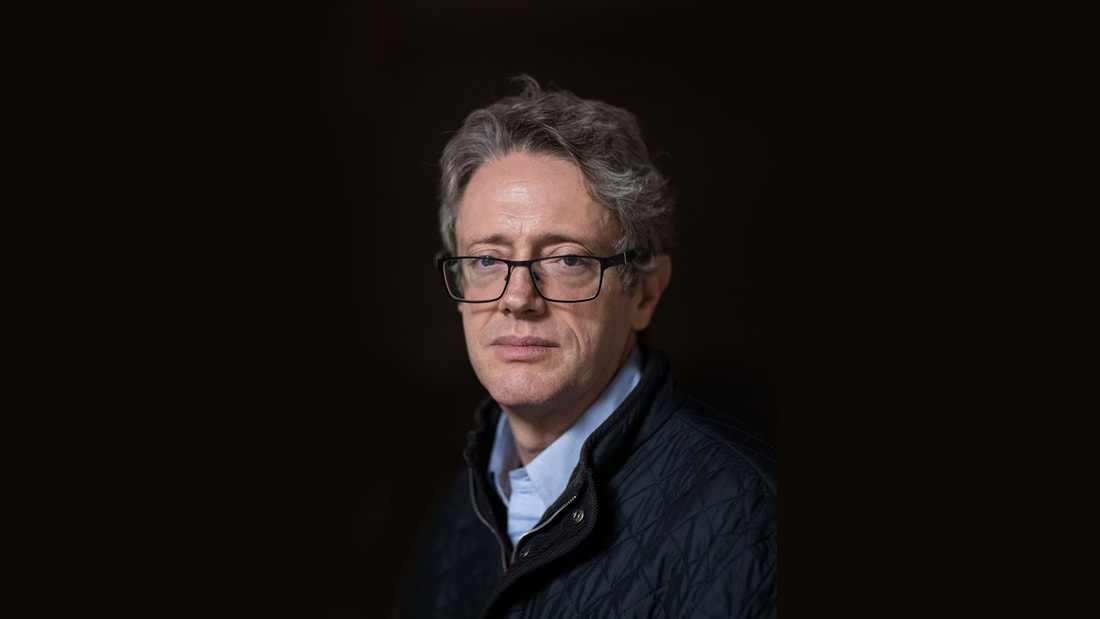
Peter Gilbert (b. 1975) is Associate Professor of Music, University of New Mexico. He has commissions and accolades from the Barlow Foundation, New Music USA, the Aaron Copland House, ZKM (Institut für Akustik und Musik), the Russolo Foundation, the Look & Listen Festival, the Third Practice Festival, and IMEB Bourges. He writes: “My music usually aspires to create a sonic architecture that helps us lose our sense of time completely and allows us to partake in a kind of more direct aural experience in search of passageways to transcendence.”
Gilbert’s music can be heard on numerous labels including New Focus Recordings and at petergilbert.net.
Here is Peter Gilbert's Soon as the Sun Forsook the Eastern Main performed by Emanuele Arciuli, piano from the album Burned into the Orange released by New Focus Recordings and available on Bandcamp.
Gilbert’s music can be heard on numerous labels including New Focus Recordings and at petergilbert.net.
Here is Peter Gilbert's Soon as the Sun Forsook the Eastern Main performed by Emanuele Arciuli, piano from the album Burned into the Orange released by New Focus Recordings and available on Bandcamp.
Robb Symposium Series Co-Artistic Director
Karola Obermüller's (b. 1977) composing, described by the New York Times as "hyperkinetic music”, is constantly in search of the unknown. After obtaining composition degrees in Nuremberg, Saarbrücken, and the University Mozarteum Salzburg, her sense of rhythm and form was forever changed by studying Carnatic and Hindustani classical music in Chennai and Delhi, India.
A Ph.D. at Harvard University brought her to the US where she taught at the University of New Mexico before joining the Department of Music at UC San Diego. She also lives and works part of the year in Europe and has been a visiting artist at ZKM, Deutsche Akademie Rom, Centro Tedesco di studi Veneziani, Akademie Schloss Solitude, Eisler House (International Hanns Eisler Scholarship), and IRCAM.
Her music, often political, always dramatic, includes operas for Staatstheater Nürnberg, Theater Bielefeld, Theater Bonn, Theater Heidelberg, Theater Aachen, and Stuttgart’s Musik der Jahrhunderte. The emotional juxtapositions of story suspended in a tableau architecture that one finds in her operas can be heard in her concert works as well. These include commissions from the Ernst von Siemens Music Foundation, the National Endowment for the Arts, the Fromm Music Foundation, New Music USA, Bayerischer Rundfunk, Saarländischer Rundfunk, and numerous renowned soloists and ensembles.
Her music can be heard on CD (WERGO, New Focus Recordings, Brilliant Classics, NEOS) and online at karolaobermueller.net.
Here is Karola Obermüller's Dehnung (2020) for daegeum, koto, gayageum, two violins, viola violoncello, double bass, and percussion performed by AsianArt Ensemble 15 May 2023, Konzerthaus Berlin. All rights reserved.
A Ph.D. at Harvard University brought her to the US where she taught at the University of New Mexico before joining the Department of Music at UC San Diego. She also lives and works part of the year in Europe and has been a visiting artist at ZKM, Deutsche Akademie Rom, Centro Tedesco di studi Veneziani, Akademie Schloss Solitude, Eisler House (International Hanns Eisler Scholarship), and IRCAM.
Her music, often political, always dramatic, includes operas for Staatstheater Nürnberg, Theater Bielefeld, Theater Bonn, Theater Heidelberg, Theater Aachen, and Stuttgart’s Musik der Jahrhunderte. The emotional juxtapositions of story suspended in a tableau architecture that one finds in her operas can be heard in her concert works as well. These include commissions from the Ernst von Siemens Music Foundation, the National Endowment for the Arts, the Fromm Music Foundation, New Music USA, Bayerischer Rundfunk, Saarländischer Rundfunk, and numerous renowned soloists and ensembles.
Her music can be heard on CD (WERGO, New Focus Recordings, Brilliant Classics, NEOS) and online at karolaobermueller.net.
Here is Karola Obermüller's Dehnung (2020) for daegeum, koto, gayageum, two violins, viola violoncello, double bass, and percussion performed by AsianArt Ensemble 15 May 2023, Konzerthaus Berlin. All rights reserved.
2025-2026 Season
The annual Robb Symposium Series aligns with The University of New Mexico's academic year, with events taking place during the fall and spring semesters. All events are free admission all ages family-friendly community events, unless otherwise noted. Visit this page regularly for new event listings.
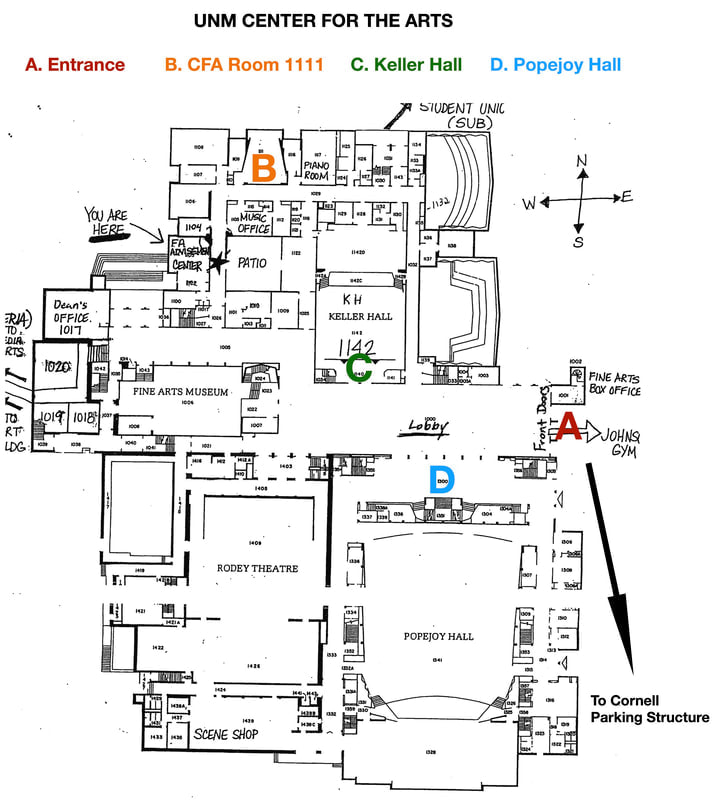
click map to expand
Venues
Center for the Arts (CFA)
University of New Mexico
College of Fine Arts
MSC04 2570
1 University of New Mexico
Albuquerque, NM 87131-0001
Directions
Map Key:
A. CFA entrance
B. CFA Room 1111
C. Keller Hall (505) 277-2131
D. Popejoy Hall (505) 277-8010
Paid visitor parking is available at the
UNM Cornell parking structure
Center for the Arts (CFA)
University of New Mexico
College of Fine Arts
MSC04 2570
1 University of New Mexico
Albuquerque, NM 87131-0001
Directions
Map Key:
A. CFA entrance
B. CFA Room 1111
C. Keller Hall (505) 277-2131
D. Popejoy Hall (505) 277-8010
Paid visitor parking is available at the
UNM Cornell parking structure
UNM Arts Lab
131 Pine Street NE @Central & University
Albuquerque, NM 87106
(505) 277-2253
Directions
Episcopal Cathedral of St. John
318 Silver Avenue SW (corner of 3rd & Silver)
Albuquerque, NM 87102
(505) 247-1581
Directions
131 Pine Street NE @Central & University
Albuquerque, NM 87106
(505) 277-2253
Directions
Episcopal Cathedral of St. John
318 Silver Avenue SW (corner of 3rd & Silver)
Albuquerque, NM 87102
(505) 247-1581
Directions
About
The Robb Symposium Series, established in the fall of 2022, is an outcropping of the celebrated annual UNM John Donald Robb Composers' Symposium. The series features concerts of new music by guest artists and UNM faculty & students, as well as masterclasses, artist talks, and workshops.
The UNM Robb Trust promotes the exploration of new music through the Robb Symposium Series. Since 1972, the internationally renowned John Donald Robb Composers' Symposium has brought composers and musicians from around the world to UNM for a series of public concerts and unique learning opportunities for UNM students. Past guest composers have included such luminaries as Anthony Braxton, John Cage, Lukas Foss, Michael Colgrass, Gordon Mumma, Raven Chacon, and Chen Yi. The legacy of the John Donald Robb Composers' Symposium continues through the Robb Symposium Series.
The Trust sponsors the biennial Robb Commission in even years. The winner is awarded a cash prize and their composition is premiered at a Robb Symposium Series concert, typically the annual Robb Concert, which takes place in the spring.
The UNM Robb Musical Trust serves as a bridge between the UNM College of Fine Arts and the New Mexico community, regularly presenting concerts of Robb’s compositions along with Hispanic folk songs, preserving and promoting the archive of 3,000+ field recordings Robb made, and collaborating with community partners in educational initiatives. Through its many activities, the Trust proudly carries on the vision of its namesake, John Donald Robb.
The UNM Robb Trust promotes the exploration of new music through the Robb Symposium Series. Since 1972, the internationally renowned John Donald Robb Composers' Symposium has brought composers and musicians from around the world to UNM for a series of public concerts and unique learning opportunities for UNM students. Past guest composers have included such luminaries as Anthony Braxton, John Cage, Lukas Foss, Michael Colgrass, Gordon Mumma, Raven Chacon, and Chen Yi. The legacy of the John Donald Robb Composers' Symposium continues through the Robb Symposium Series.
The Trust sponsors the biennial Robb Commission in even years. The winner is awarded a cash prize and their composition is premiered at a Robb Symposium Series concert, typically the annual Robb Concert, which takes place in the spring.
The UNM Robb Musical Trust serves as a bridge between the UNM College of Fine Arts and the New Mexico community, regularly presenting concerts of Robb’s compositions along with Hispanic folk songs, preserving and promoting the archive of 3,000+ field recordings Robb made, and collaborating with community partners in educational initiatives. Through its many activities, the Trust proudly carries on the vision of its namesake, John Donald Robb.
ARCHIVE
John Donald Robb Composers' Symposium
predecessor of the Robb Symposium Series
2023 | 2022 | 2021 (2021 addendum)
2020 | 2019 | 2018 | 2017 | 2016 | 2015 | 2014 | 2013 | 2012 | 2011
2010 | 2009 | 2008 | 2007 | 2006 | 2005 | 2004 | 2003 | 2002 | 2001
2000 | 1999 | 1998 | 1997 | 1996 | 1995 | 1994 | 1993 | 1992 | 1991
1990 | 1989 | 1988 | 1987 | 1986 | 1985 | 1984 | 1983 | 1982 | 1981
1980